• Home
  • Software
  • Hardware
  • Artificial Intelligence
  • GAMING
  • NEWS
  • CONTACT
FacebookTwitterInstagramYoutube

Gosoftwarecity

Banner
Gosoftwarecity
  • Home
  • Hardware
  • HighPoint RocketAIC 7608AW Review: The Fast Gets Even Faster with 56 GB/s of Throughput
Hardware

HighPoint RocketAIC 7608AW Review: The Fast Gets Even Faster with 56 GB/s of Throughput

by Edward Horton11/18/20250633
Share0

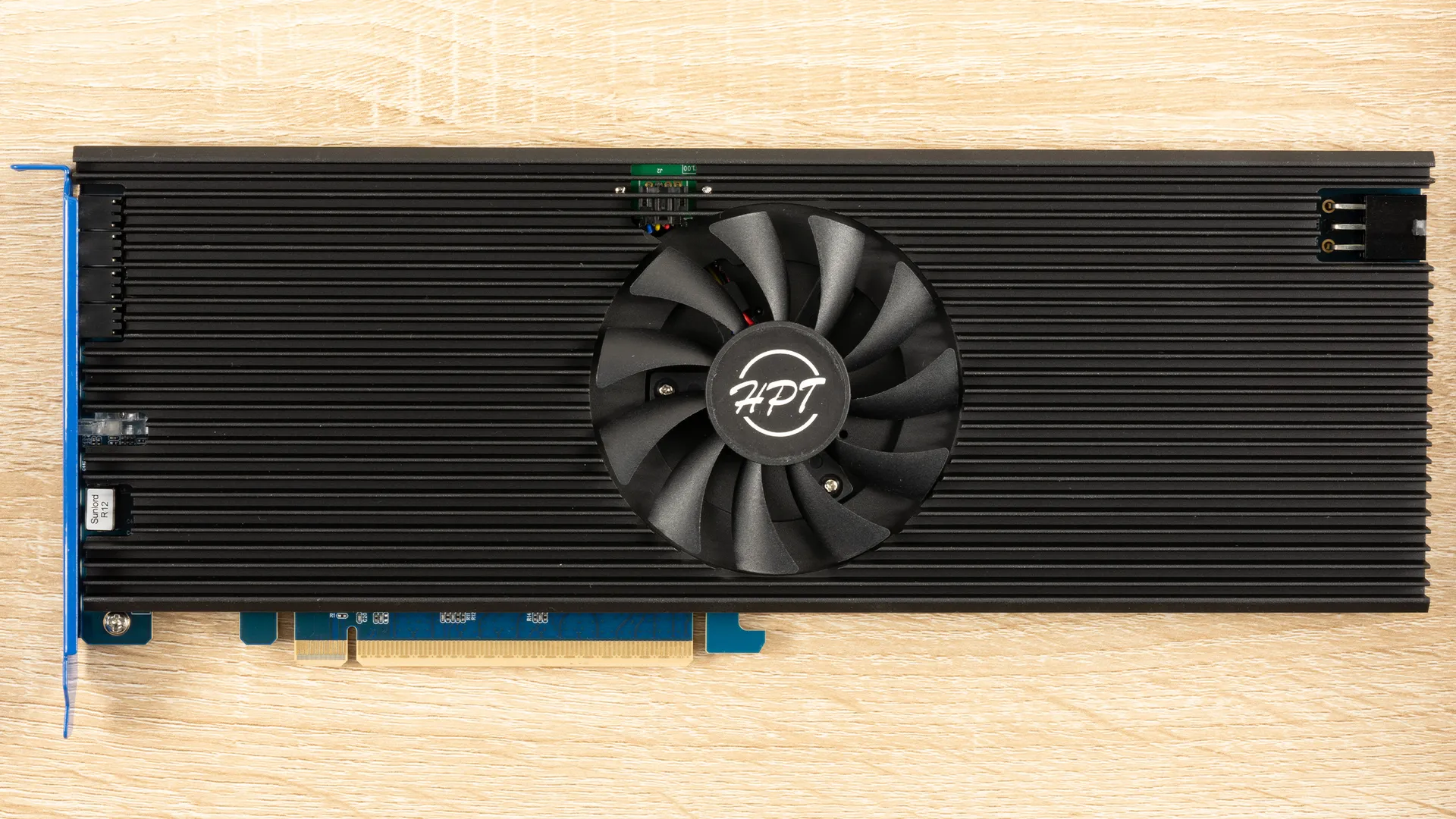
In its review, Tom’s Hardware calls the HighPoint RocketAIC 7608AW “a beastly storage solution”, emphasising that while it makes very strong claims for performance, it’s aimed at a niche audience rather than the average consumer.

Key Specs & Features

  • The add-in card supports eight NVMe SSDs in M.2 slots (2242/2260/2280) on a PCIe 5.0 x16 upstream link.

  • A maximum theoretical throughput of up to 56 000 MB/s (56 GB/s) is quoted.

  • Supports hardware RAID levels: RAID 0, RAID 1, RAID 10.

  • Hardware secure encryption (TCG Opal) and hardware secure boot.

  • Actively-cooled aluminium heatsink, dual-layer thermal padding, and a tool-less M.2 slot design.

  • Broad OS support (Windows + Linux) and management via Web GUI, CLI and UEFI.

  • MSRP of the card itself: around US$1,999, not including the NVMe SSDs needed to populate it.

Performance & Use Case

The review notes that this card currently achieved the highest throughput figures the testers had seen in their storage tests — the best they’d tested to date. They filled the card with eight 8 TB Samsung 9100 Pro SSDs to stress it. The card is described as ideal for “AI, serious content creation or SOHO server tasks”.

However — and this is important — the review warns that the card isn’t appropriate for most “normal” desktop or consumer use. Its cost, complexity and high performance demands mean that only certain workflows (large-scale media editing, server workloads, high-end storage arrays) really make sense for it.

Pros & Cons

Pros

  • Up to 64 TB capacity (depending on SSDs used).

  • Extreme performance via PCIe 5.0 support.

  • Full RAID software + management stack included.

  • Built-in hardware encryption and secure boot.

Cons

  • Very high overall cost (card + SSDs).

  • Very few everyday consumer scenarios where the full performance can be utilised.

  • Extra power draw, need for good cooling and likely PC platform geared toward high end.

Who Should Consider It?

According to the review: if you are a user working in video production, editing high resolution media, building workstation storage arrays, doing AI training or deploying a small server/NAS and you are comfortable with hardware/RAID/config complexity — this card can deliver state-of-the-art performance.

If instead you are a regular gamer, general workstation user or average enthusiast with one NVMe SSD, the review suggests you’ll get far better price-to-value from a simpler NVMe drive rather than this high-end solution.

Final Thoughts

Tom’s Hardware concludes that the RocketAIC 7608AW lives up to its promise of “the fastest thing we’ve tested to date” in terms of throughput. They emphasise the niche status: great if you need it, but overkill for most. The review implies a future-proofing value for high-end workflows, but caution on cost and use case.

In short: there’s no substitute for this level of performance — just very limited scenarios where it’s the right tool.

Share0
previous post
70 Percent of Major Cyber Breaches Linked to “Toxic Combinations” of Risks
next post
Nvidia Becomes the First Public Company Worth $5 Trillion
Edward Horton
We welcome you to explore our website and immerse yourself in the world of software. Join our community, stay informed, and make informed decisions that will transform your software experience. Together, let’s unlock the full potential of technology and shape a brighter digital future.

Related posts

The State of PC Building in 2026: Component Trends and Buying Guide

04/27/2026

3 Strategies for Avoiding GPU Thermal Throttling

Edward Horton03/23/2025

Micron Set to Release GDDR7 Memory in the First Half of 2024, Fueling Next-Generation GPUs

Edward Horton04/14/2025

Leave a Comment Cancel Reply

Save my name, email, and website in this browser for the next time I comment.

Recent Posts

LG France: Innovation Meets Everyday Life — TVs, Home Appliances & More

Edward Horton05/26/2026
05/26/2026

EndNote 2025 Review: The AI-Powered Reference Manager That Saves Researchers Hours Every...

05/21/2026
05/21/2026

Cooling Innovations: Keeping High-Performance Hardware Under Control

05/10/2026
05/10/2026

How Apple Silicon Changed the Processor Landscape Forever

05/06/2026
05/06/2026

Next-Gen Storage: The Road to 100TB Hard Drives and Beyond

05/02/2026
05/02/2026

Popular Posts

The Next Generation of Gaming Graphics: DLSS 5 and Real-Time Ray Tracing

03/31/2026
03/31/2026

Recommerce – Smart Tech, Second Life, Superior Value

Edward Horton04/15/202605/18/2026
04/15/202605/18/2026

Anthropic “Hacks” Claude’s Brain — And the AI Notices:...

Edward Horton12/15/2025
12/15/2025

GPU Wars 2026: Nvidia vs AMD vs Intel —...

04/23/2026
04/23/2026

User Demonstrates iOS 17’s StandBy Mode Running on iPhone...

Edward Horton12/11/2024
12/11/2024

Categories

  • Artificial Intelligence
  • Gaming
  • Hardware
  • News
  • Software
  • Uncategorized

Editor's picks

LG France: Innovation Meets Everyday Life — TVs, Home Appliances & More

Edward Horton05/26/2026
05/26/2026

Recent posts

LG France: Innovation Meets Everyday Life — TVs, Home Appliances & More

Edward Horton05/26/2026
05/26/2026

EndNote 2025 Review: The AI-Powered Reference Manager That Saves Researchers Hours Every...

05/21/2026
05/21/2026

Contact

  • Home
  • About Us
  • Contact Us
  • Term of Use
  • Privacy Policy

Newsletter

Subscribe my Newsletter for new blog posts, tips & new photos. Let's stay updated!

@2024 - gosoftwarecity.com. All Right Reserved.
  • Home
  • About Us
  • Contact Us
  • Term of Use
  • Privacy Policy
Gosoftwarecity
FacebookTwitterInstagramYoutube
  • Home
  • Software
  • Hardware
  • Artificial Intelligence
  • GAMING
  • NEWS
  • CONTACT