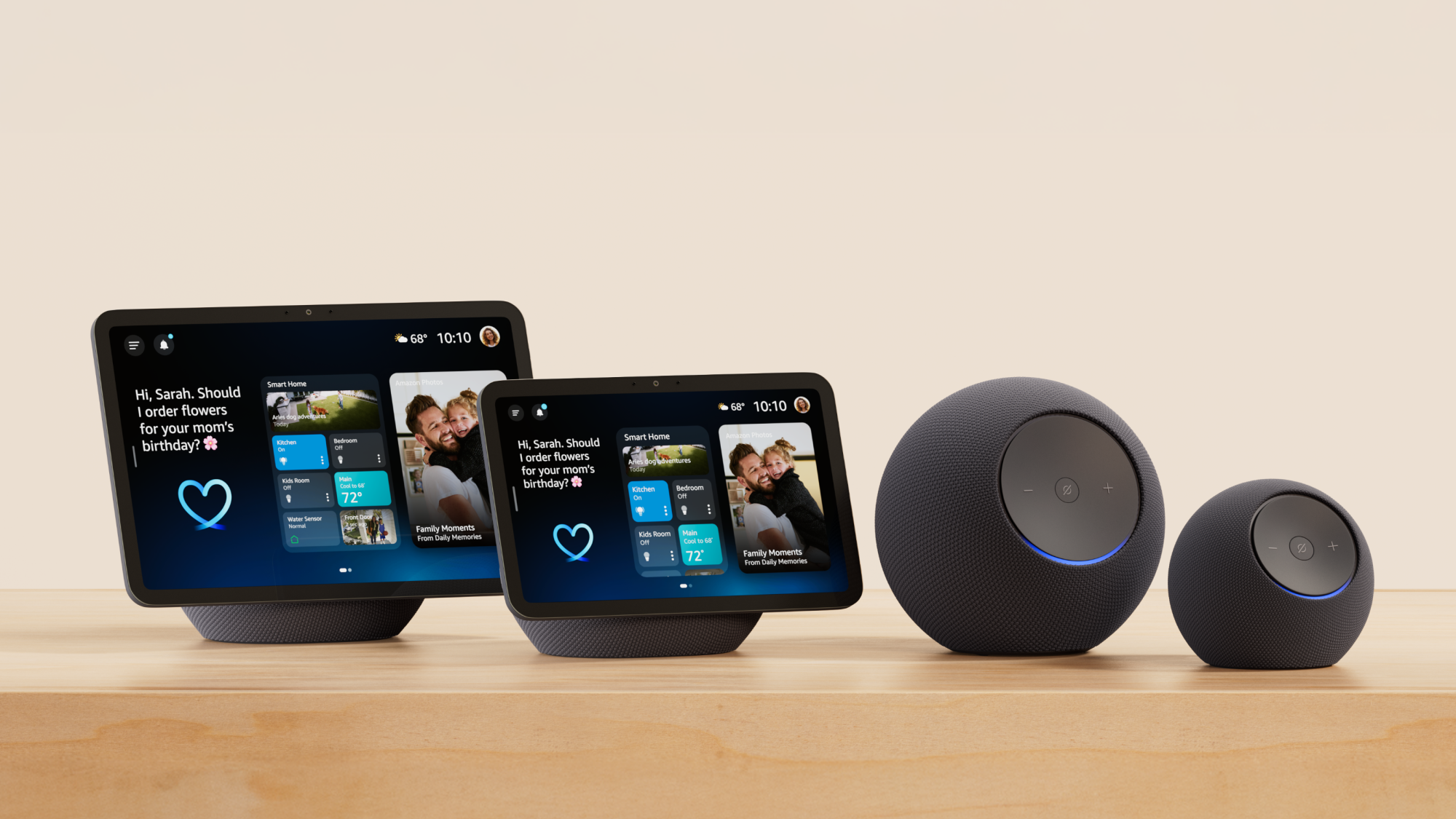
At its annual hardware event in New York, Amazon introduced a bold new generation of Echo devices purpose-built for its upgraded AI assistant, Alexa+. With four new models unveiled and significant advances in both hardware and on-device intelligence, the company is staking its claim in the smart-home era where voice, ambient sensors and generative AI converge.
A Hardware Sequel Built Around AI
Amazon’s new lineup includes the Echo Dot Max, Echo Studio, Echo Show 8 and Echo Show 11. The Dot Max is a reinvention of the small smart-speaker category: a two-way speaker with a woofer and tweeter, delivering “nearly 3× the bass” of prior Echo Dot models. The Echo Studio, meanwhile, sees a radical redesign—40 % smaller than its predecessor—while packing spatial-audio, Dolby Atmos, and premium drivers.
The two Show models bring screens into the mix: both have 13-megapixel cameras, stereo front-facing speakers, custom woofers, and are engineered around Amazon’s “OmniSense” sensor platform which draws from audio, ultrasound, Wi-Fi radar, accelerometers and traditional cameras to detect user presence and ambient context throughout the home.
Underpinning all of these models is new silicon. The AZ3 chip powers the Dot Max; the AZ3 Pro (which adds support for large language models and vision transformers) powers the Studio and Show models. Amazon claims the wake-word detection performance is improved by over 50 %. More than just talk, these chips and sensors signal a push toward ambient AI: devices that proactively sense and adapt, rather than await a user’s voice command.
Alexa+: The Generative AI Core
At the heart of the hardware push is Alexa+. This next-generation version of Amazon’s voice assistant is built on generative AI foundations, enabling more natural conversation, memory of past interactions, richer multi-modal understanding, and smarter, home-wide awareness. Previously, Alexa mainly answered queries and executed commands; now it can summarize events, anticipate needs, integrate deeply with smart-home sensors, and adapt its behaviour based on context.
Amazon is bundling Alexa+ with its new hardware and making it free to Prime members (with a standalone subscription option too). The company envisions Alexa+ as the central hub of a smart home: it can blend voice, vision and ambient sensing data to deliver insights like “you left the garage door open” or “here’s a summary of today’s deliveries and who came by.” In this vision, the Echo devices cease being passive speakers and become active home-companions.
Why This Matters
This move represents several strategic shifts:
From voice assistant to ambient intelligence: Rather than simply responding when spoken to, the new Echo line is designed to detect presence, movement, and context. It means Amazon is targeting a future of “always-aware” devices rather than reactive ones.
Differentiation through hardware + sensors + AI: Many smart home ecosystems focus on software or cloud-services. Amazon is leveraging custom silicon, sensor platforms and new devices to lock in its hardware advantage—much as it has done in tablets and TVs.
Upsell into services and ecosystem lock-in: With Alexa+ as a driver, the new hardware creates more opportunity for usage, data capture, and thereby deeper integration with Amazon’s services (shopping, streaming, smart-home subscriptions).
Competitive signal: Amazon is sending a message to rivals in smart home (such as Google and Apple) that it’s playing aggressively in the ambient AI space, not simply in smart speakers.
Challenges and Questions Ahead
While the announcement is compelling, Amazon faces several hurdles:
Privacy and trust: As devices become more “aware,” capturing sensor data, audio, video and Wi-Fi radar traces, users will ask: how much data is stored, processed, analyzed? Amazon must provide clear transparency and controls.
Fragmented hardware experience: Only the new devices carry the full sensor/AI stack. Owners of older Echo models may not get full benefit, which can cause fragmentation and user frustration.
Delivering value beyond novelty: Ambient AI is one thing; meaningful everyday value is another. Amazon must show that the sensors and intelligence translate into useful features people will trust and rely on, not just gimmicks.
Execution and rollout: New chips and sensors introduce manufacturing complexity and cost. Amazon must hit shipping timelines and avoid supply issues or performance complaints.
Ecosystem and developer support: For Alexa+ to thrive, Amazon needs strong developer buy-in and third-party integrations so the assistant doesn’t feel locked-in and limited compared to open platforms.
What’s Next
Amazon is rolling out the new Echo devices for pre-order immediately, with shipping starting in October for some models and November for others. The company will also expand Alexa+ to broader markets over time, and likely introduce additional AI-enabled features such as:
More advanced smart-home routines triggered by ambient sensors (e.g., door opens, motion, Wi-Fi changes)
On-device AI processing (to improve latency, privacy)
Enhanced sensors for health, wellness and context (Alexa+ might proactively suggest an activity or reminder based on behaviour patterns)
Deeper integration with Amazon services (shopping suggestions, home-security alerts, multi-device coordination)
Developer tools and APIs to tap into the Azure-style multi-modal capabilities of Alexa+ (language + vision + sensor fusion)
Final Thoughts
Amazon’s September 2025 hardware event marks a pivotal moment: the Echo devices are no longer just smart speakers—they’re the core interface for a future ambient-intelligence home built around Alexa+. By combining custom silicon, sensor platforms and generative AI, Amazon is positioning itself at the intersection of hardware, AI and services.
Whether it succeeds will depend less on the pieces and more on how smoothly they integrate and how compelling the everyday experience becomes for users. If Amazon delivers noticeably smarter behaviour, seamless automation and trustworthy privacy, then the new Echo line could mark the start of a new era in smart home technology. If not, the hardware may simply be a louder version of what already exists.
Either way, the message is clear: Amazon is aiming to transform how we interact with our homes, our voices and our digital assistants—and the new Echo devices are the front-line of that ambition.