In today's visually driven world, photo editing software has become an essential tool for photographers, graphic designers, and anyone who wants to enhance their images. With numerous options available, it can be overwhelming to choose the right photo editing software for your needs. To help you make an informed decision, here are six of the best photo editing options available today.
The list below is deliberately mixed. It includes professional tools that cost a monthly subscription, a one-time-purchase alternative that competes directly with Adobe, a RAW converter with a different philosophy, and a free open-source editor that is genuinely capable. Which one is "best" depends less on features than on how you work: whether you shoot RAW, whether you edit tethered, whether you want to pay once or monthly, and how much of your workflow happens on a phone or tablet.
1. Adobe Photoshop
Adobe Photoshop has long been the industry standard for professional photo editing. It offers a comprehensive set of tools and features, including advanced retouching, color correction, and precise editing capabilities. With its extensive plugin support and integration with other Adobe Creative Cloud applications, Photoshop remains a powerful choice for photographers and designers.
Photoshop is a pixel editor first and a photo workflow tool second. That distinction matters: it is unbeatable for compositing, retouching, masking, and detailed local adjustments, but it is not where you organise and cull a shoot. Most photographers pair it with Lightroom rather than choosing between them.
Recent versions have added AI-assisted tools that speed up common jobs — generative fill for extending or removing parts of an image, automatic subject selection, and improved masking. These features are genuinely useful, but they are also the reason Adobe's subscription model is easier to justify than it used to be.
Best for: professionals and serious enthusiasts who need precise control, compositing, and retouching.
Watch out for: the learning curve. Photoshop rewards time invested, but it is not the fastest tool for a simple crop-and-grade job.
2. Lightroom
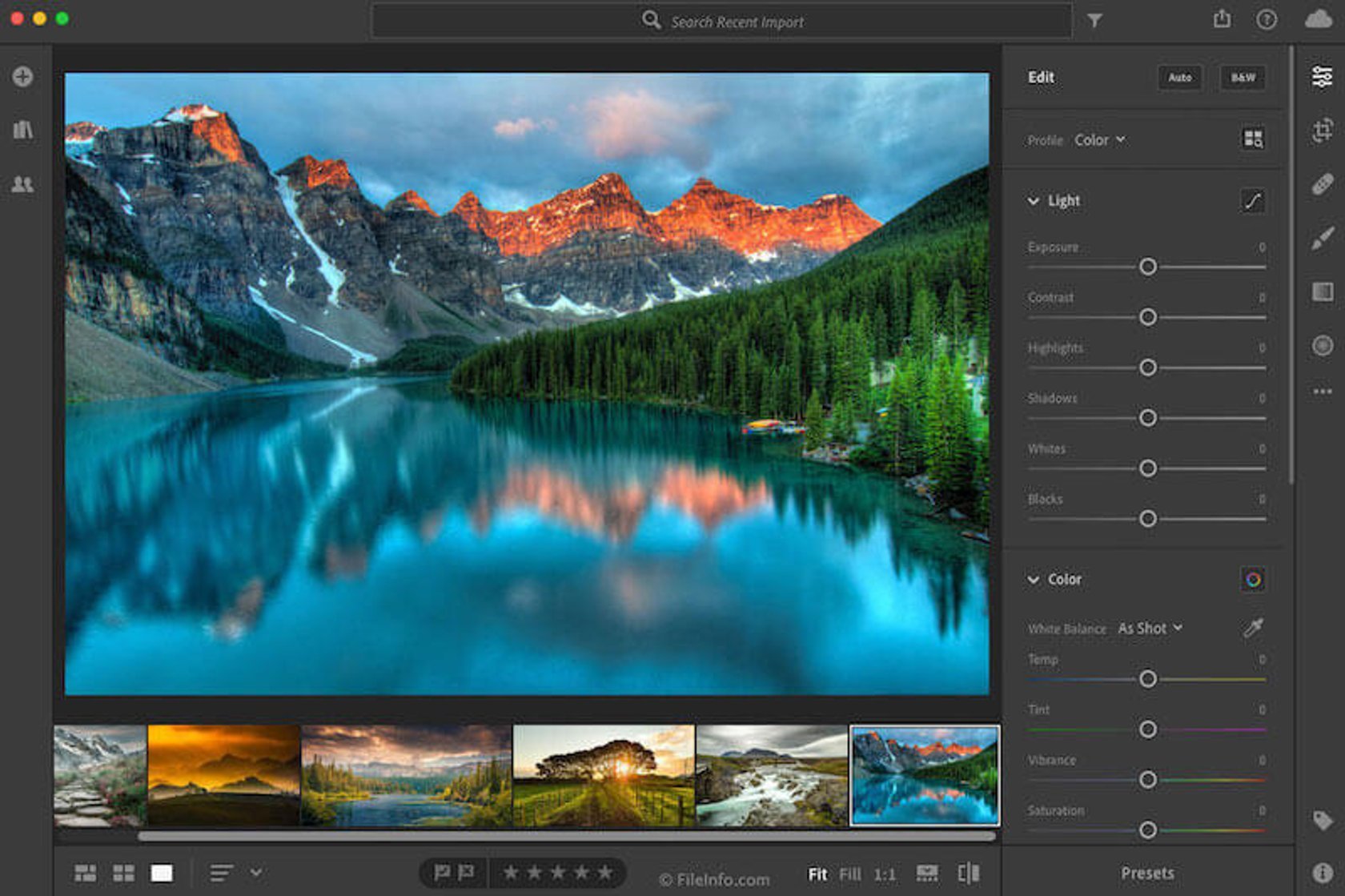
Also developed by Adobe, Lightroom is specifically designed for photographers who need efficient organization and seamless editing capabilities. It offers powerful photo management features, including cataloging, keyword tagging, and batch editing. Lightroom's non-destructive editing workflow and intuitive interface make it an excellent choice for both professionals and enthusiasts.
Lightroom is built around a catalog: you import images, organise them with collections, keywords, and ratings, and edit non-destructively. Because the edits are stored as instructions rather than baked into the file, you can revisit and change them at any time, and you can sync them across devices with the cloud version.
The two versions of Lightroom serve different needs. Lightroom Classic is the desktop-first option with a local catalog, favoured by photographers with large archives. The cloud-based Lightroom is leaner and syncs to phone and tablet, which suits people who want to edit on the move.
Best for: photographers whose main job is organising, culling, and developing large numbers of RAW files.
Watch out for: the catalog model, which some users find rigid compared with a simple folder-based workflow.
3. Capture One
Capture One is a high-end photo editing software known for its exceptional image quality and precise color editing. It provides advanced tools for tethered shooting, noise reduction, and lens correction. Capture One's RAW file editing capabilities and powerful adjustment layers make it a preferred choice among professional photographers.
Capture One's reputation rests on two things: colour handling and tethering. Studio and commercial photographers often choose it because it renders skin tones and product colours the way they expect, and because its tethered capture is fast and stable during a shoot. Its sessions model is also better suited to project-based work than a single large catalog.
It is available as a subscription, and Capture One has also offered perpetual licences for some versions, which matters if you prefer to avoid an ongoing cost. Check the current licensing options before you commit, because the model has changed over time.
Best for: studio, commercial, and product photographers who shoot tethered and care about colour accuracy.
Watch out for: the price, and the fact that its interface assumes you already know what you are doing.
4. Affinity Photo
Affinity Photo is a robust and affordable alternative to Adobe Photoshop. It offers a wide range of professional editing tools, including advanced retouching, layer blending, and HDR support. Affinity Photo's user-friendly interface, non-destructive editing, and excellent performance make it a popular choice for photographers and digital artists.
The main draw is the pricing model. Affinity Photo has historically been sold as a one-time purchase rather than a subscription, which makes it dramatically cheaper over several years than an Adobe plan. It runs on Windows, macOS, and iPad, and it handles RAW files, layers, masks, and focus stacking without feeling like a cut-down tool.
It does not have the same ecosystem as Adobe — no Lightroom-style catalog, fewer third-party plugins, and a smaller pool of tutorials — but for a photographer who wants a capable editor without a monthly bill, it is the most obvious alternative.
Best for: photographers and designers who want professional editing tools without a subscription.
Watch out for: fewer integrations and a smaller community than Adobe's ecosystem.
5. DxO PhotoLab
DxO PhotoLab is known for its advanced image processing capabilities and automatic corrections. It features intelligent algorithms that enhance image quality, reduce noise, and correct lens distortions. DxO PhotoLab's comprehensive set of editing tools and excellent RAW conversion make it a powerful option for photographers looking for automated enhancements.
PhotoLab's strength is the combination of optical corrections and noise reduction. Because DxO has its own lens and camera database, it can correct distortion, vignetting, and chromatic aberration automatically, using a profile for your specific combination of body and lens. Its denoising, particularly for high-ISO files, is among the best available.
It is sold as a perpetual licence, with optional add-on modules. The workflow is different from Lightroom's: it is more focused on the image in front of you than on managing a large library, which suits photographers who develop a shoot and hand off the results.
Best for: photographers who shoot in low light or with difficult lenses and want the best automatic corrections.
Watch out for: the interface can feel idiosyncratic, and the library tools are less developed than Lightroom's.
6. GIMP
GIMP (GNU Image Manipulation Program) is a free and open-source photo editing software that offers a wide range of features comparable to premium options. It provides tools for retouching, layer editing, and color correction. GIMP's active community and extensive plugin support make it a popular choice for budget-conscious users and those who prefer open-source software.
GIMP is not a lightweight toy. It supports layers, masks, curves, level adjustments, and a huge range of brushes, and it can be extended with plugins and scripts. It runs on Windows, macOS, and Linux, and it costs nothing.
The trade-offs are real: the interface is less polished than commercial tools, colour management can be fiddly, and it lacks some of the automated features that make modern editors fast. But for retouching, compositing, and general editing on a budget, it is entirely capable.
Best for: students, hobbyists, and anyone who needs a capable editor at zero cost.
Watch out for: the interface, which is the main reason people give up on it.
What is the best photo editing software for you?
If you are looking for an editor that is simple and free, but can handle basic edits, GIMP might be the right choice. This editor isn't going to help you improve your photo editing abilities, but it's perfect for those who don't have a photographic background and need to make small adjustments to a few images.
We recommend Adobe Lightroom for more experienced photo editors and photographers. It comes with Adobe Photoshop as part of the Photography and Creative Cloud Plan. You'll have access to the latest editing features when they release.
If a subscription is a dealbreaker, Affinity Photo is the closest thing to Photoshop without a monthly fee, and DxO PhotoLab is the better choice if your priority is RAW quality and automatic lens corrections.
When selecting photo editing software, consider factors such as your level of expertise, specific editing needs, budget, and compatibility with your operating system. Each software mentioned above offers unique features and advantages, catering to different user preferences and requirements.
A simple way to decide:
- You shoot large volumes of RAW files and need to organise them: Lightroom.
- You retouch, composite, or need precise local control: Photoshop or Affinity Photo.
- You shoot tethered in a studio: Capture One.
- You want the best automatic corrections with a one-time purchase: DxO PhotoLab.
- You need a capable editor for free: GIMP.
Whichever you choose, the software is only part of the workflow. A calibrated monitor, a consistent backup routine, and a clear naming system for your files will improve your results more than any single feature. Start with the tool that matches how you actually work, and upgrade only when a specific limitation starts to cost you time.
These six photo editing options provide photographers and designers with powerful tools to enhance and transform their images. Whether you're a professional photographer seeking precise control or an enthusiast looking for user-friendly software, there is an option here that fits your editing needs and budget.